
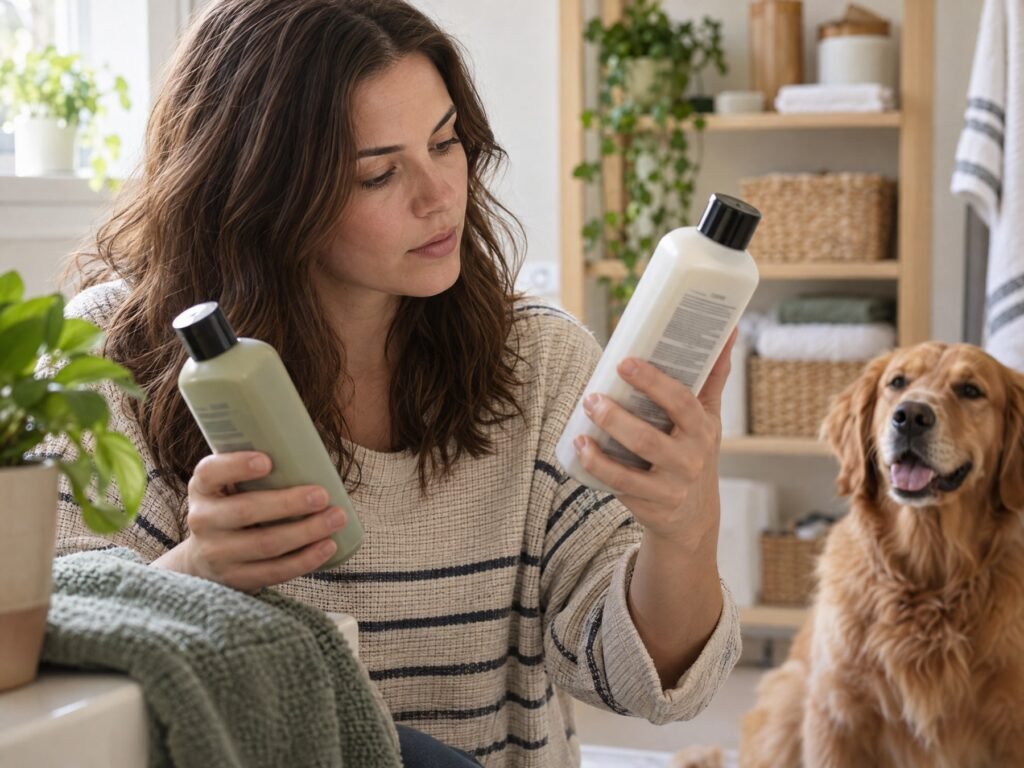
A good bath starts with a dog-specific shampoo and a calm, careful routine.
A clean, fresh-smelling dog is lovely. But a shampoo that leaves the strongest perfume—or wins a quick cleaning demo—isn’t automatically the best choice for your dog. The better questions are whether the formula is made for dogs, whether you can understand what’s in it, whether it suits your pet’s skin and coat, and whether you can use and rinse it as directed.
What the original four-shampoo comparison looked at
We compared four Chinese-market products across price, ingredient descriptions, packaging, cleaning performance, and how long the fragrance seemed to last. Its photos showed the bottles and label panels, different pump or pour-top designs, and a forearm marked with eyeliner letters. For its cleaning demo, the reviewer rubbed each shampoo over a marked area 50 times and compared how much of the eyeliner remained.
That setup is useful as a reminder to look beyond a pretty label, but it cannot establish which shampoo works best on dogs. Eyeliner on a person’s arm is not dog dirt on a coat.
The original price comparison is concerns products sold in China, so its prices and product conclusions should not be carried over to U.S. shelves. Instead, use its five comparison categories as a checklist—and interpret each one carefully.
1. Start with a shampoo made for dogs
Choose a product labeled for dogs rather than reaching for your own shampoo. Human products are formulated for human skin, and some ingredients or fragrances can irritate a dog’s skin. The ASPCA recommends choosing grooming products made for the species they are intended for and checking with your veterinarian if you are unsure what suits your pet. A veterinarian writing for PetMD also explains that human shampoo may disrupt a dog’s skin and coat care and can be harder to rinse away completely.
If your dog has persistent itching, redness, flakes, sores, or a strong odor that keeps returning, don’t try to solve the problem by switching fragrances. Skin problems and odor can have underlying causes, and the ASPCA advises contacting a veterinarian when irritation or ongoing odor is present.
2. Read the label for clarity, not for “chemical-free” promises
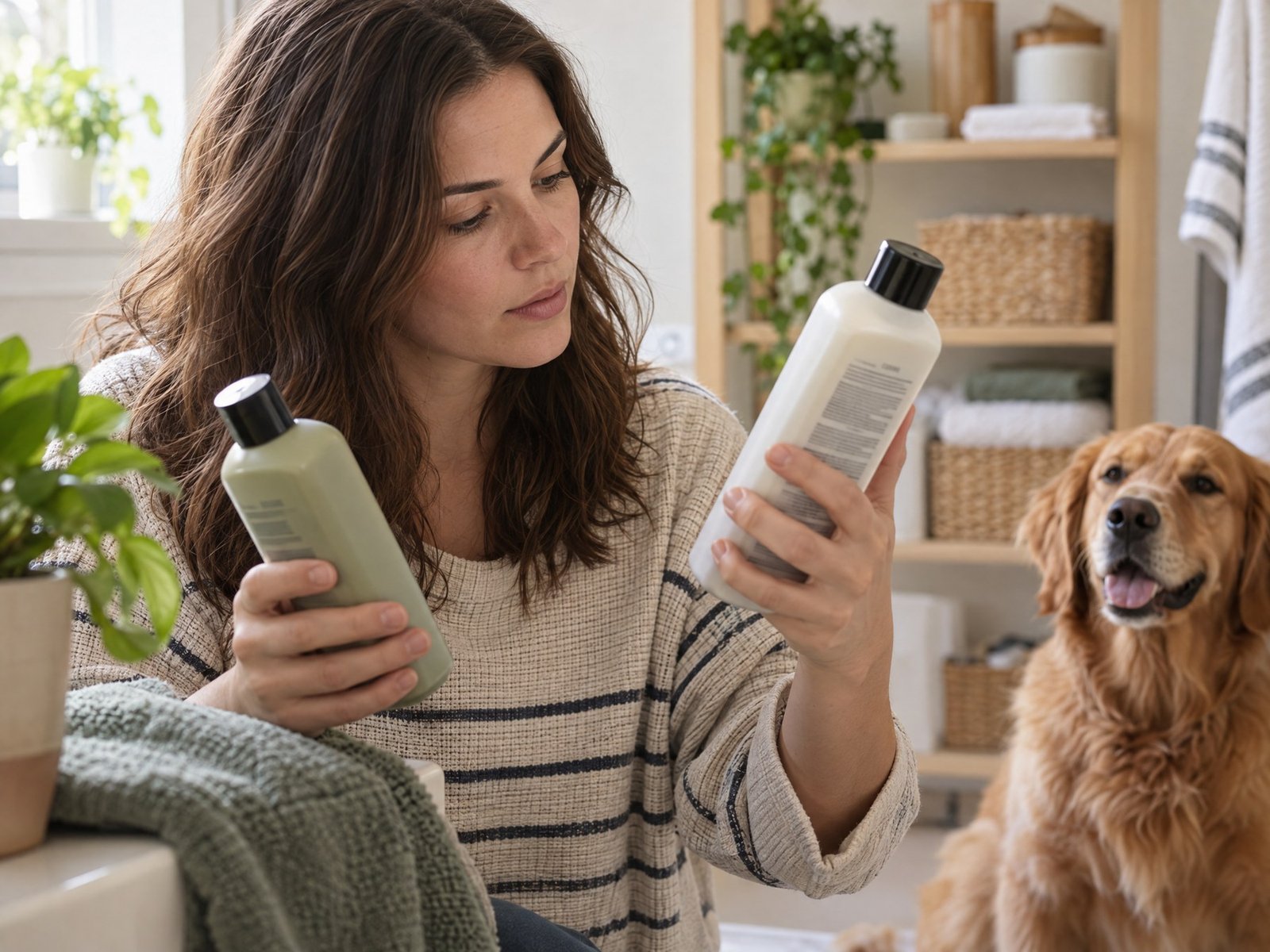
Check the label for information you can understand; this illustrative image does not depict specific products.
That is a reasonable consumer question: if you want to compare formulas or avoid a known sensitivity, specific information is more useful than a vague catch-all phrase.
Still, a long ingredient list is not automatically bad, and a short list is not proof that a product is safer. Ingredients serve different functions, and the label alone does not tell you how a finished formula will work for an individual dog. Don’t assume that an unfamiliar ingredient is harmful—or that “natural,” “tearless,” or “gentle” means risk-free. If the label leaves you uncertain, ask the manufacturer for clarification or show it to your veterinarian.
There is also a U.S.-specific point worth knowing: FDA guidance says products intended solely to cleanse or beautify animals are generally considered grooming aids and are not regulated by FDA under the Federal Food, Drug, and Cosmetic Act. A product marketed to treat or prevent disease, or to affect the body’s structure or function, may instead be considered an animal drug. Don’t assume an ordinary grooming aid has been reviewed or approved by FDA as a treatment.
3. Choose packaging you can control with wet hands
We compared pump dispensers with pour-style openings. Pumps can make one-handed use and portioning easier; a well-designed cap can also be convenient. The useful question is not which format is universally best, but which one lets you dispense the amount you need without fumbling beside a wet, wiggly dog.

A pump can help control the amount dispensed when your hands are wet.
Check that the cap closes securely and that the bottle is easy to handle in your bathing space. If the directions call for dilution, follow them and prepare only what you need for that bath. Do not assume a concentrated product should be used full strength—or that every shampoo should be diluted the same way.
4. Think of “cleaning power” as a real-bath question
The eyeliner demonstration made for a dramatic before-and-after photo, but it measured removal of makeup from skin after a set number of rubbing motions. It did not measure how a shampoo cleans a dog’s coat, how it rinses out of dense fur, or whether the dog’s skin tolerates it.

A real bath shows whether the shampoo spreads through the coat and rinses away as directed.
For a household purchase, follow the product directions and pay attention to whether the shampoo spreads through your dog’s coat and rinses out thoroughly. A strong lather or perfume is not, by itself, proof of better cleaning. The ASPCA recommends keeping shampoo away from a dog’s eyes, ears, and nose and rinsing carefully during a bath. If your veterinarian prescribes a medicated shampoo, ask about the exact bathing routine and contact time; therapeutic products may need to be used differently from routine grooming shampoos.
5. Compare value—and treat fragrance as a preference
Its top-rated shampoo cost nearly four times as much as its least expensive option. That comparison is not a current U.S. price guide, but it points to a useful habit: compare price per fluid ounce and read the directions before deciding which bottle is the better value. A lower shelf price may not tell you how much product you will use per bath, and a premium price does not prove a better result.
Fragrance is a preference, not a measure of skin health or cleaning performance. A strong scent may be unpleasant for some people or dogs, and fragrance can bother a sensitive pet. If your dog seems uncomfortable after a bath—such as with new redness, itching, or repeated face rubbing—stop using the product and contact your veterinarian if symptoms persist or are severe.
A simple way to make your choice
Pick a dog-specific shampoo whose label and instructions you can understand. Match it to your dog’s coat and any known sensitivities, and ask your veterinarian before using a medicated product or trying to manage an ongoing skin problem. Compare cost per ounce, choose a dispenser you can handle safely, and don’t let a long-lasting scent or a one-off cleaning demo make the decision for you.
Bathing needs vary. The ASPCA says many dogs can be bathed at least every three months, while dogs that spend more time outdoors or have skin problems may need more frequent baths. For a dog with a skin condition, your veterinarian can recommend the right product and schedule for that individual pet.